
Why Lee County Has No Public Warrant Search
No official form lets the public pull every active warrant in Lee County at once. The Sheriff's Office website does not post a full warrant clearance tool, and warrants are issued by more than one court. Because of that, a warrant check runs through a chain of official sources rather than a single database.
The closest public tool is the Sheriff's Most Wanted page, which lists selected wanted persons. For a name that is not on that list, the next steps are the Sheriff's phone line and the court that would have issued the warrant. The main Sheriff's Office number is (662) 432-2600, and non-emergency dispatch answers at 662-432-2622 or 662-432-2623. Staff cannot always confirm an active or sealed warrant to a third party over the phone, so the person named on the warrant or an attorney usually gets the clearest answer.
The full chain looks like this. Start with the Most Wanted page. Use the Sheriff's main line or the Submit a Tip option for wanted-person information, but never use a tip form for a crime in progress; call 911 or dispatch instead. Check the Sheriff's mobile app, which carries a Wanted Persons feature. For a missed court date or unpaid fine, contact Justice Court at 662-432-2500 or Tupelo Municipal Court at 662-841-6516. For a felony capias or indictment warrant, the Circuit Clerk and county criminal courts hold the record. When no list answers the question, a public records request to the Sheriff is the last formal channel.
Types of Warrants in Lee County
Warrants in Lee County come from different courts and serve different purposes. Knowing the type helps a person reach the right office, since a bench warrant from Justice Court is handled very differently from a felony capias out of Circuit Court. The definitions below cover the warrant categories a resident is most likely to encounter.
- Arrest warrant
- Issued after a judge finds probable cause that a person committed a crime, authorizing law enforcement to take that person into custody.
- Bench warrant
- Ordered by a judge for a missed court date, a missed payment, contempt, or failure to comply with a court order.
- Capias / capias pro fine
- A court command for a failure to appear or pay, directing officers to bring the person before the court or collect a fine.
- Search warrant
- Authorizes a search of a person, place, or item; it is usually not public before it is executed.
- Fugitive warrant or hold
- Used when another county or state has charges, allowing local officers to hold the person for that jurisdiction.
Active and sealed warrants may not be safely disclosed by phone to outside callers. A person who wants to clear a warrant should confirm the issuing court, the case number, the bond amount, and whether a court appearance or a jail surrender is required.
Lee County Most Wanted and Tip Lines
The Sheriff's Most Wanted page is the closest thing Lee County offers to a public warrant lookup. It asks whether the reader has information about a crime or a wanted individual, lists the phone number (662) 432-2600, and links to a Submit a Tip option. The page also warns readers not to attempt to apprehend anyone listed.
The official source for these notices is the Lee County Sheriff Most Wanted page, which carries wanted-person photos and descriptions when the list is published.
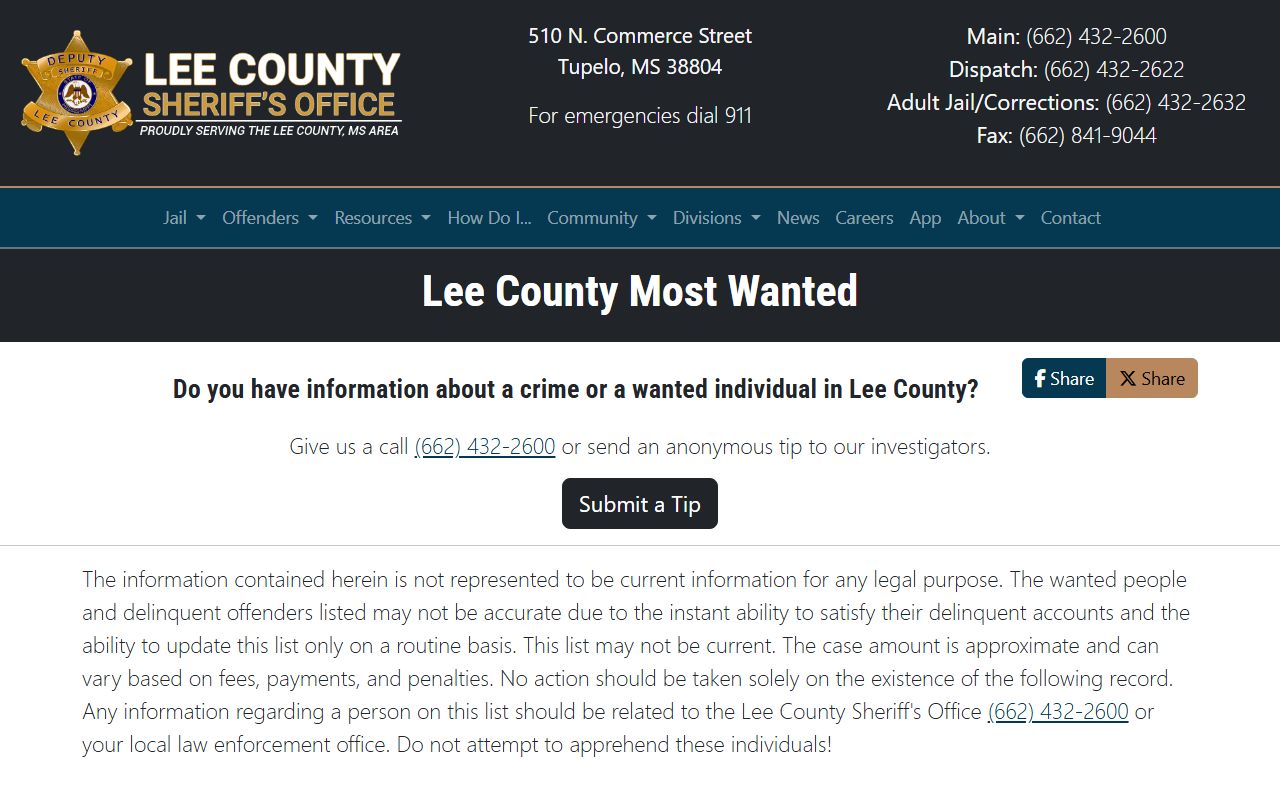
At inspection the office noted that it was updating the most-wanted list and asked visitors to check back, a reminder that the page is a notice board and not a live warrant index. Tips can go through the website or the app, but the office is clear that the tip channel is not for a crime in progress.
Important: The Most Wanted page states its information may not be current for legal purposes, since accounts can be satisfied instantly and the list updates only on a routine basis; never act on it alone or try to apprehend anyone.
Lee County Sheriff App Wanted Persons
The Lee County Sheriff mobile app is an official channel that carries a Wanted Persons feature alongside other tools. It is worth knowing plainly what the app does and does not do. The app bundles wanted persons, inmate information, alerts, a sex offender registry, a shelter locator, and quick contact options into one mobile interface, but the warrant-related view is the same kind of wanted-person notice found on the website, not a complete warrant search.
The Sheriff describes the features on the official mobile app page, which explains that users can report incidents, see wanted persons, access inmate details, submit tips anonymously, and receive alerts.
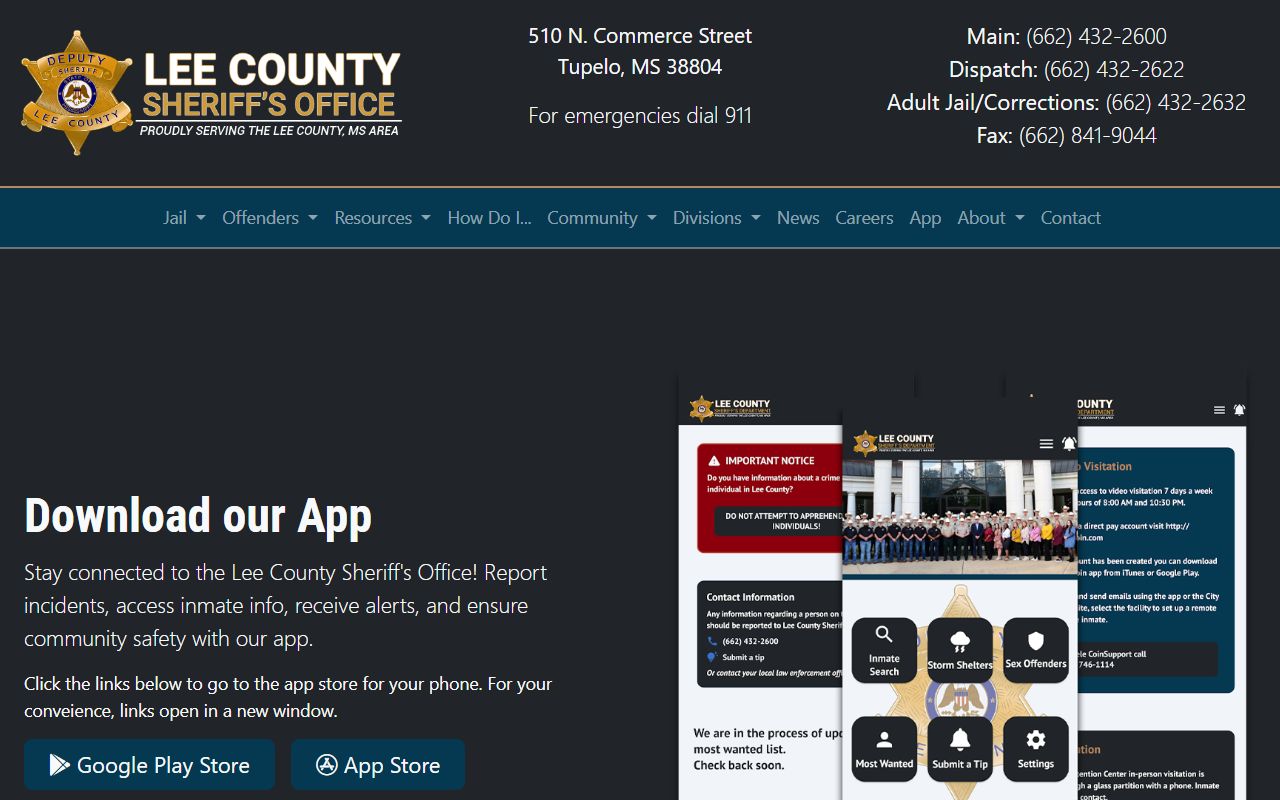
Because the app packages several lookups in one place, it is a convenient mobile companion for residents who want alerts and wanted-person notices on a phone. It still points back to the same Sheriff's Office for any official warrant confirmation.
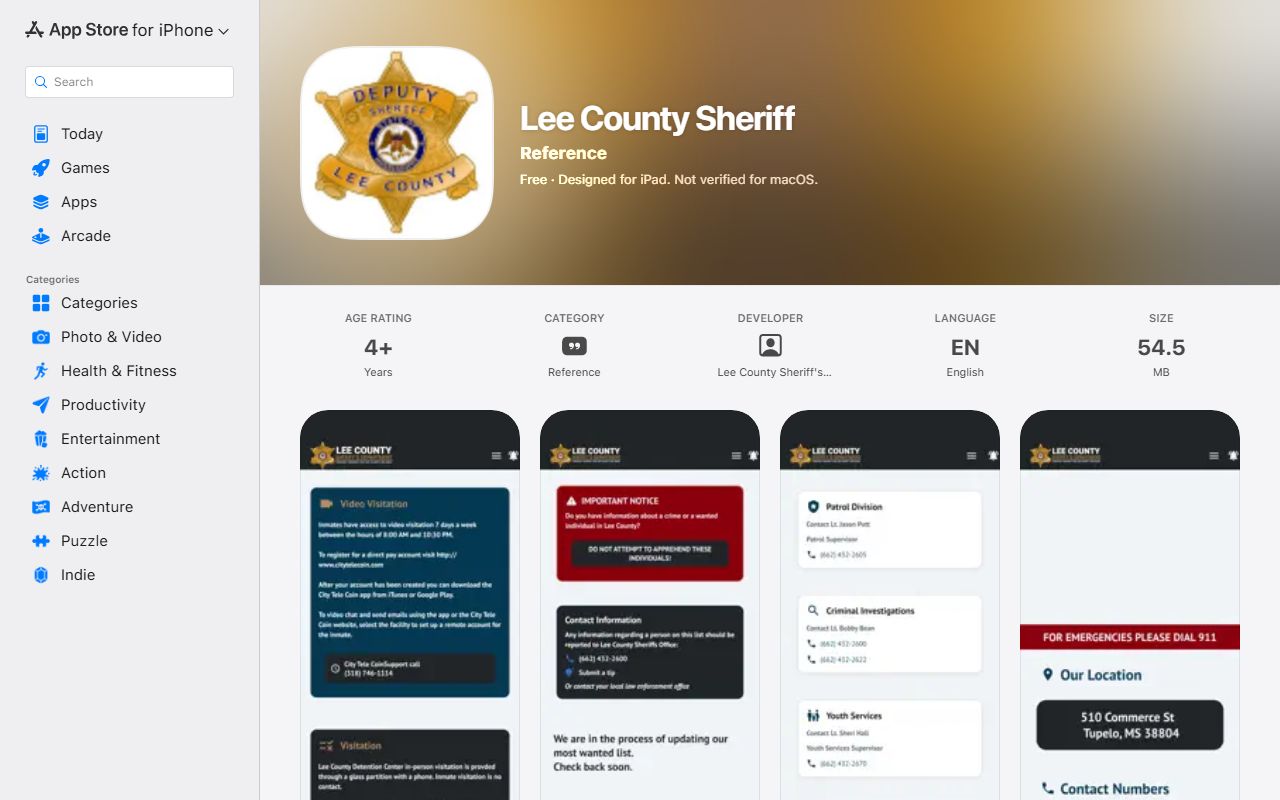
The iPhone version is published as a free reference app on the Apple App Store listing, where the release history shows the app first appeared in late 2025.
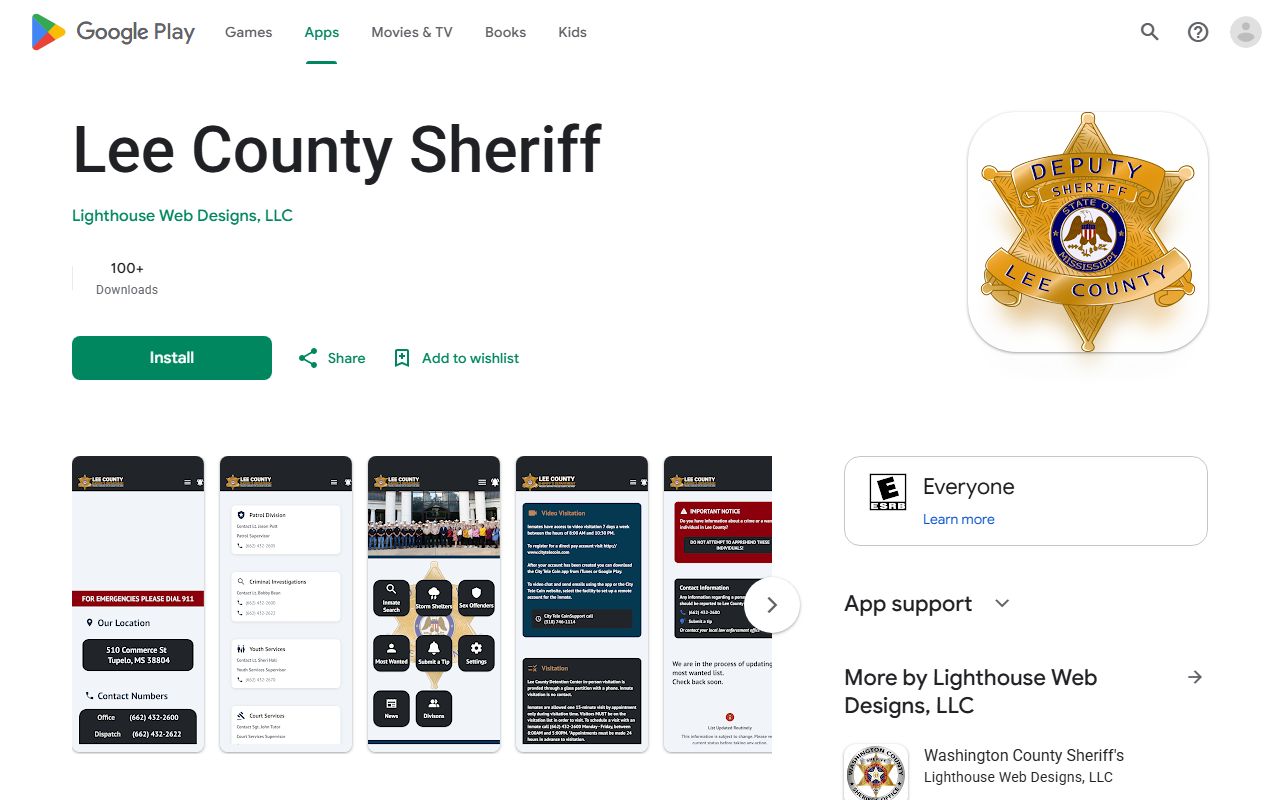
The same app is available for Android phones, and the store page describes its inmate search, booking details, and registry tools in more detail.
Android users can install it from the Google Play listing, published by Lighthouse Web Designs, which lists the wanted-person, inmate-search, and push-notification features.
For booking details on someone already in custody, the app and the jail roster overlap, and the county Lee County inmate records page covers the roster search in full.
Bench Warrants in Justice and Municipal Court
Many Lee County warrants never reach the Sheriff's Most Wanted page because they are bench warrants from lower courts. These come from a missed court date, an unpaid fine, or a failure to comply on a traffic, misdemeanor, or eviction matter. The court that ordered the warrant is the office that can recall it, so the first task is to identify that court.
Justice Court handles traffic tickets, misdemeanors, small civil claims, and evictions, and a failure to appear there can trigger a bench warrant. Court-date questions go to 662-432-2500. City citations and ordinance cases run through Tupelo Municipal Court, which lists a phone line and set walk-in hours for bond surrenders. The contacts below cover the two courts where local bench warrants most often originate.
| Court | Handles | Phone | Notes |
|---|---|---|---|
| Lee County Justice Court | Traffic, misdemeanor, eviction, small civil | 662-432-2500 | Court-date and warrant questions; ticket payment in person or online. |
| Tupelo Municipal Court | City citations and ordinance cases | 662-841-6516 | Bond-surrender walk-ins Monday, Tuesday, or Thursday 1:30-3:00 p.m. |
A bond surrender lets a person resolve a city warrant by appearing during the listed window and posting bond rather than waiting to be picked up. Anyone unsure which court issued a warrant can ask the clerk to confirm the case number and the amount owed before showing up.
Felony Capias and Circuit Court Warrants in Lee County
Felony warrants in Lee County route through the Circuit and County criminal systems rather than the lower courts. A capias issued after an indictment, a probation revocation warrant, or an appeal-related warrant is tied to a Circuit Court case file. These records are reached through the Circuit Clerk and the court administrator, not the Sheriff's Most Wanted list.
The Lee County Circuit Clerk sits at 200 W. Jefferson St. in Tupelo and answers at (662) 432-2300. The clerk can confirm whether a Circuit or County criminal case exists and point a caller toward the right contact, though not every case document is open for anonymous public viewing. Felony case status, charges, and any related capias live in that file. For the full criminal case behind a felony warrant, including charges and disposition, the county Lee County criminal court records page explains how those files are organized.
Because Lee sits in a multi-county First Circuit district, scheduling and calendar tools for these cases are largely attorney-facing and require a registered login. That leaves the Circuit Clerk as the practical public contact for confirming a felony warrant or capias.
What a Lee County Warrant Record Shows
When the Sheriff does publish a wanted-person notice, it carries a set field layout. The Most Wanted page uses labeled fields for the listed individual along with status images that mark whether a warrant has been served or recalled. The inventory below reflects the field labels seen on the official page.
| Field | What It Shows |
|---|---|
| Name / photo | The wanted person's name and, when published, a booking-style photo. |
| Race | Listed race of the individual. |
| Sex | Listed sex of the individual. |
| Eye Color | Recorded eye color. |
| Hair Color | Recorded hair color. |
| Bond Amount | Approximate bond figure, which can vary with fees, payments, and penalties. |
| Last Known Location | Last reported location for the wanted person. |
| Aliases | Other names the person is known to use. |
| Wanted For | The offense or reason the warrant was issued. |
| Status images | Arrested Warrant and Recalled Warrant labels marking a warrant's current state. |
The page also carries a plain currency disclaimer. It states the listed information may not be current for legal purposes, that accounts can be satisfied instantly, and that case amounts are approximate. A reader should treat the bond figure and the listing itself as a snapshot, then confirm details with the issuing court before acting on them.
How to Resolve a Lee County Warrant
Clearing a warrant is mostly about reaching the right office in the right order. A stale online list is not enough, since a warrant can stay active in court systems after a notice comes down. The steps below follow the path the Sheriff and the courts expect a person to take.
- Identify whether the warrant is the Sheriff's, Circuit or County, Justice, or Municipal.
- Call the relevant court or the Sheriff's Office, and do not rely only on a stale online list.
- For Tupelo municipal matters, note the bond-surrender walk-in hours from the official court portal.
- Ask whether bond can be posted, whether a new court date can be set, and what payment methods are accepted.
- If represented, let the attorney contact the clerk or prosecutor before any surrender.
- Bring ID, the case or citation number, and a payment method, and expect arrest and booking if the warrant requires custody.
- After the matter is resolved, confirm the warrant is recalled and allow time for the systems to update.
Important: Talk to a lawyer before turning yourself in, since an attorney can often arrange bond, set a court date, or contact the prosecutor before any surrender takes place.
Restricted Lee County Warrant Records
Not every warrant record is open for a public lookup. Mississippi favors public access to government records under the Public Records Act, but the law lets other statutes, court rules, and court orders close specific records. Active, sealed, and investigatory warrants often fall outside ordinary public copy access.
For records that are open, a public records request to the Sheriff is the formal route. The Sheriff's records page covers arrest and release forms and background checks, with a $5 fee for a background check and an arrest or release form at $5 for the first copy and $1 for each additional copy. Warrant records themselves may be limited where a case is still active, sealed, or part of an open investigation. The framework for these requests is the Mississippi Public Records Act, which sets out how public bodies handle written requests and copy costs.
Some warrants stay confidential regardless of the request. Juvenile and Youth Court matters are protected by statute and are not ordinary public files. Search warrants are generally not public before they are executed. Federal warrants are handled by federal agencies and courts, separate from county systems. For any of these, the office that holds the record, the court of record, or an attorney is the correct contact rather than an open search.