
What Probate Covers in Lee County
Probate is the legal process of settling a person's affairs after death. It also reaches into the care of people who cannot manage their own money or decisions. In Lee County the Chancery Court is the venue for all of it. Estates, will contests, guardianships, conservatorships, minor settlements, and mental-health commitments are equity matters, and equity is the Chancery Court's job.
The work splits between two roles. The Chancery Court and its chancellors hear the petitions and sign the orders. The Chancery Clerk keeps the files, takes the filings, and furnishes copies to the public. A person searching for an estate file, a notice to creditors, or a guardianship order starts with the Chancery Clerk, not the Circuit Clerk who handles felony and civil cases on the other side of the building.
Lee County also runs a County Court that shares some civil jurisdiction, but it does not take over probate. Wills and estates stay in Chancery. That single fact answers most of the confusion people have about where to file or where to look.
Probate Terms Defined
Estate paperwork is full of words that rarely come up anywhere else. A short glossary makes the petitions, notices, and orders far easier to read before you request a copy or walk into the clerk's office.
- Testator
- The person who made the will. A testator names who gets the property and who should carry out those wishes.
- Executor
- The person named in a will to carry it out. The court issues letters that give the executor authority to act for the estate.
- Intestate
- Dying without a valid will. When that happens, state law decides who inherits and the court appoints an administrator.
- Guardianship
- A court arrangement giving one person legal charge of a minor or of an adult who cannot care for themselves or their affairs.
- Conservatorship
- A court arrangement placing an adult's finances and property under the management of an appointed conservator.
How to Search Lee County Probate Records
There is no free countywide portal that pulls up every Lee County estate file by name. The search is hands-on and starts with the Chancery Clerk. Members of the public may come in and ask for a Chancery court file, and copy fees apply once staff retrieve it. For records tied to land, the county runs an online system that helps when an estate touches real property.
The Chancery Records Online portal, known as CRMS, is the digital front door for land and Chancery-adjacent property records. The portal page for the Lee County Chancery Records Online search system lists the office hours, mailing address, and phone alongside its search choices. CRMS is strongest for deeds, liens, and land-linked filings, so it helps most when a probate matter involves property that changed hands; full estate case access should still be confirmed with the clerk.
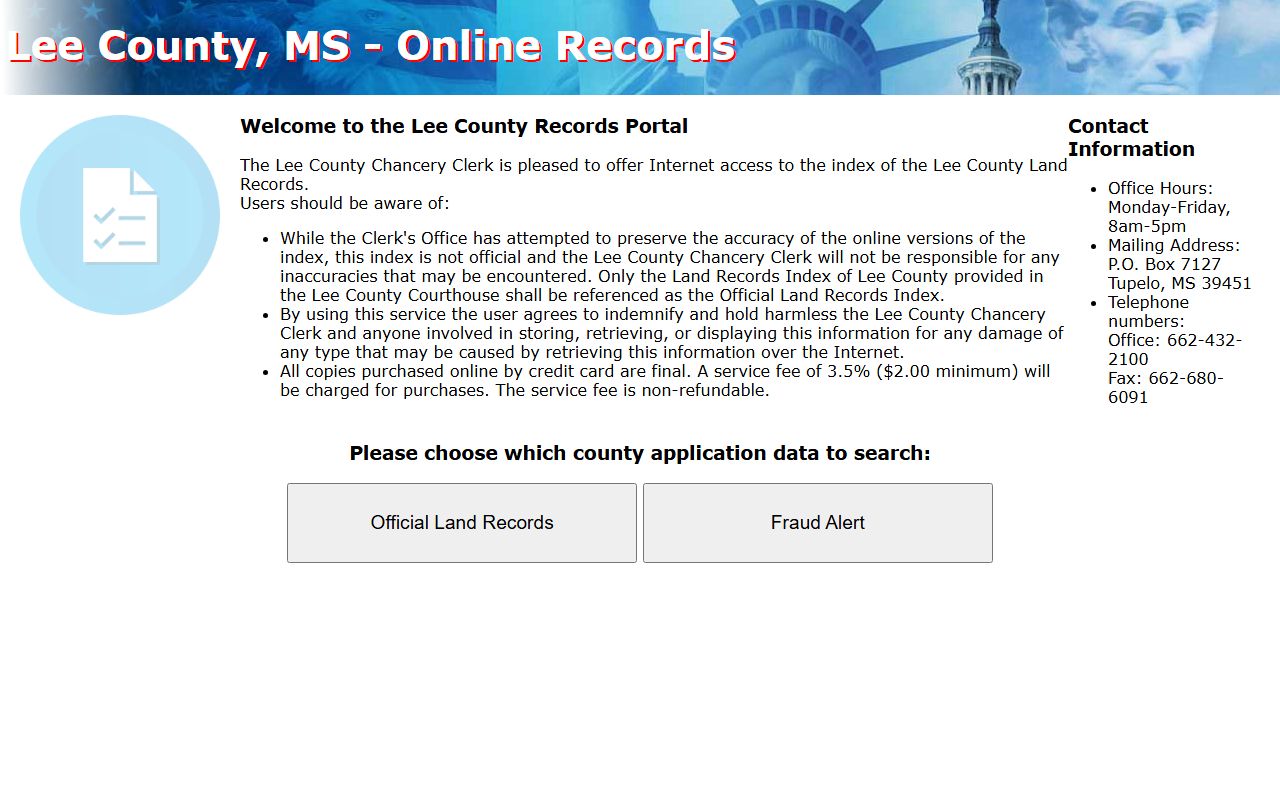
The land-record search shown above is useful for estate property questions, but wills, guardianships, and sealed matters are not opened through that screen. For those, the counter and the mail process remain the route.
- Decide what you actually need: a will, an estate file, a guardianship or conservatorship record, or a land-linked document tied to an estate.
- For land-linked records, search CRMS first, then note any document numbers you find.
- Contact the Lee County Chancery Clerk at (662) 432-2100 to confirm the file exists and learn the copy cost.
- Request copies in person at the counter, or by mail with payment and a stamped self-addressed envelope.
- For a hearing date or a continued case, call the Chancery Court Administrator rather than the records counter.
Where Lee County Probate Cases Are Filed
Two offices matter most for estate work. The Chancery Clerk is the records custodian and the copy counter. The First Chancery Court District provides the chancellors who decide the cases and the court administrator who manages the calendar. Both sit at the Lee County Justice Center in downtown Tupelo. The contact cards below give the direct lines for each.
Lee County Chancery Clerk
Bill Benson, Chancery Clerk
P.O. Box 7127
Tupelo, MS 38802
(662) 432-2100
Fax: (662) 680-6091
Monday-Friday 8:00 a.m.-5:00 p.m.
First Chancery Court District
Lee County Justice Center
200 West Jefferson Street
Tupelo, MS 38804
(662) 432-2130
Court Administrator: Beth Burnett McNutt
P.O. Box 7395, Tupelo, MS 38802
The First Chancery Court District covers eight counties: Alcorn, Itawamba, Lee, Monroe, Pontotoc, Prentiss, Tishomingo, and Union. The chancellors who sit across the district are Jacqueline Mask, Michael Malski, Stephen T. Bailey, and Bradley D. Tennison. A hearing date, a reset, or a question about which chancellor is assigned should go to the court administrator at the number above or to the attorney of record.
What Lee County Probate Records Show
An estate file grows as the case moves. It opens with a will or a petition and fills out with the orders, notices, and accountings that close the estate. The exact contents depend on whether the person left a will and on the size and type of the estate.
Common documents in a Lee County probate file include the will itself, the petition for probate or administration, and the order appointing an executor or administrator. From there a file may hold the notice to creditors, an inventory of assets, petitions to sell property, periodic accountings, guardianship or conservatorship papers, minor settlement records, and the final accounting that wraps the case. Land transfers tied to the estate often appear in the Chancery Clerk's recorded land records as well, which is where the CRMS portal earns its keep.
- Will and any codicils filed for probate
- Petition for probate or letters of administration
- Order appointing the executor or administrator
- Notice to creditors and proof of publication
- Inventory and appraisal of estate assets
- Annual or final accountings and distribution orders
Marriage and divorce filings live in a separate track even though divorce is also a Chancery matter; those sit with the records covered on the Lee County marriage and divorce records page. Keeping the two straight avoids a wasted request at the wrong counter.
Chancery Court Copy Fees
The Chancery Clerk publishes a clear set of copy charges, and they apply to probate files the same way they apply to land records. What you pay depends on who pulls and copies the pages and whether you need a certified copy for legal use. The fee page that lists these charges is shown below.
The cover page for the Lee County Chancery Clerk records and copy fee schedule spells out the per-page rates and the mail-request rules. Certification matters when a court, bank, or title company needs proof that a copy is true to the original.
Using the published rates above, the table breaks down what a routine probate copy request costs and how the office takes payment.
| Item | Amount |
|---|---|
| Copies made by the public | $0.25 per page |
| Copies made by Chancery Clerk staff | $0.50 per page |
| Certification of a document | Additional $1.00 |
| Payment by mail | Check or money order, payable to Lee County Chancery Clerk, with a stamped self-addressed envelope |
| In-office payment | Cash, check, money order, or credit/debit card with a 2.9% card fee on court costs and land transactions |
| Formal probate filing fee | Fee not published in official Lee County sources; call the Chancery Clerk |
Note: A mail request must identify the document well enough for staff to find it, so include names, a case or file number if you have one, and the date.
Estate Records and the Chancery Clerk Counter
Older estate files often predate any digital index, which makes the clerk's counter the best starting point for historic probate work. Bill Benson has served as Lee County Chancery Clerk since 1992, and his office is the local hub for Chancery copies, land records, recording, and the document trails that estates leave behind. The clerk's role and copy duties are described in more depth on the Lee County Chancery Clerk page.
The First Chancery Court District site is the place to confirm which chancellors and staff handle Lee County matters. Its homepage for the First Chancery Court District names Lee as a served county, lists the chancellors, and gives the Justice Center address used for filings and hearings.

The district page above ties the courtroom side to the records side, so a researcher can match a chancellor's order to the file kept by the Chancery Clerk. When an estate involves real property, pairing the recorded land records with the case file gives the fullest picture of how assets moved.
Restricted Probate Records in Lee County
Not every Chancery file is an open book. Mississippi's Public Records Act, Miss. Code Ann. Section 25-61-1 and following, favors public access, yet it yields when another statute or a court order makes a record confidential. Several probate-adjacent matters fall into that protected group.
Guardianship and conservatorship files often hold sensitive financial and medical details, so parts of them may be shielded even when the case exists on the docket. Mental-health and commitment proceedings are Chancery matters as well, but they carry health and personal information that keeps them out of the ordinary public copy stream. Records involving minors get extra protection, and adoption records are sealed outright. The Chancery Clerk's own guidance tells the public to contact an attorney for adoption files rather than request them at the counter, consistent with the adoption-confidentiality language in Miss. Code Section 93-17-25.
For these restricted categories, the route is not the public copy desk. Contact the assigned attorney, the court administrator, or the proper agency. The Mississippi Public Records Act explains the general right of access and the exemptions that limit it, which is the framework that decides what a clerk can hand over.
Note: Active estate disputes and sealed matters may not be discussed by phone with third parties, so bring identification and a case number when you visit in person.