
How to Search Lee County Court Records
Lee County has no single free portal that searches every court at once. Each court level keeps its own records, so the search starts with the record type and the court that handled it. Circuit, County, and Youth Court cases begin with the Lee County Circuit Clerk. Divorce, probate, land, and equity matters begin with the Chancery Clerk. Traffic tickets, misdemeanors, evictions, and small civil claims sit with the Justice Court, while city citations route to the Tupelo Municipal Court. The statewide Mississippi Electronic Courts system supports e-filing, but anonymous public viewing of full case documents is limited.
A few details speed the work. Have the full name of a party, a case or citation number if you know it, and the approximate filing date. Many older files and most lower court records are not online, so a phone call or a counter visit may be the only way to reach them. Copy and certification fees apply at most offices. For a deeper walkthrough of each channel, the Lee County court records page maps the same offices in detail.
- Identify the court level from the record type. Felony and larger civil cases route to Circuit Court; County Court handles its civil, misdemeanor, youth, and appeal divisions; Chancery handles divorce, estates, land title, and equity; Justice Court handles traffic, misdemeanors, small civil claims, and evictions; Tupelo Municipal Court handles city citations.
- For Circuit, County, or Youth records, contact the Circuit Clerk at the Justice Center on West Jefferson Street in Tupelo, or call the office directly.
- For Chancery records, contact the Chancery Clerk, and use the county's Chancery Records Online portal for land and property records.
- For Justice Court traffic and small civil matters, use the county Justice Court page and its ticket payment link.
- For Tupelo city citations, use the official Tupelo Municipal Court search and payment portal.
- For records that are not online, file a public records or copy request with the office that holds the file, and include payment and a return envelope when mailing.
The Tupelo Municipal Court portal is one of the few Lee County tools that lets the public search and pay without a subscriber login. Its search screen accepts several different identifiers, and the basic fields display publicly even before sign in.
| Field Label | Type | Notes |
|---|---|---|
| Citation Number | text | Search by citation tab. |
| DL Number | text | Used with state and date of birth. |
| State | dropdown | All U.S. state options. |
| Date of Birth | date | Format MM/DD/YYYY. |
| License Plate Number | text | Used with the state dropdown. |
| First / Last Name | text | Used together with date of birth. |
| Business Name | text | Business name search. |
The Lee County Judicial System
Mississippi does not use one unified trial court. Lee County cases divide among Circuit Court, County Court, Youth Court, Chancery Court, Justice Court, and Tupelo Municipal Court. Circuit Court is the trial court of general jurisdiction for felonies and for civil actions of $3,500 and above. Lee County sits in the First Circuit Court District alongside Alcorn, Itawamba, Monroe, Pontotoc, Prentiss, and Tishomingo Counties. The bench named for Lee County Circuit Court includes judges Paul S. Funderburk, Michael P. Mills Jr., John R. White, and Kelly L. Mims.
The Mississippi Judiciary publishes a plain overview of how these courts fit together, set out on the Mississippi court structure page. That overview frames the trial and appellate levels that govern every Lee County case.
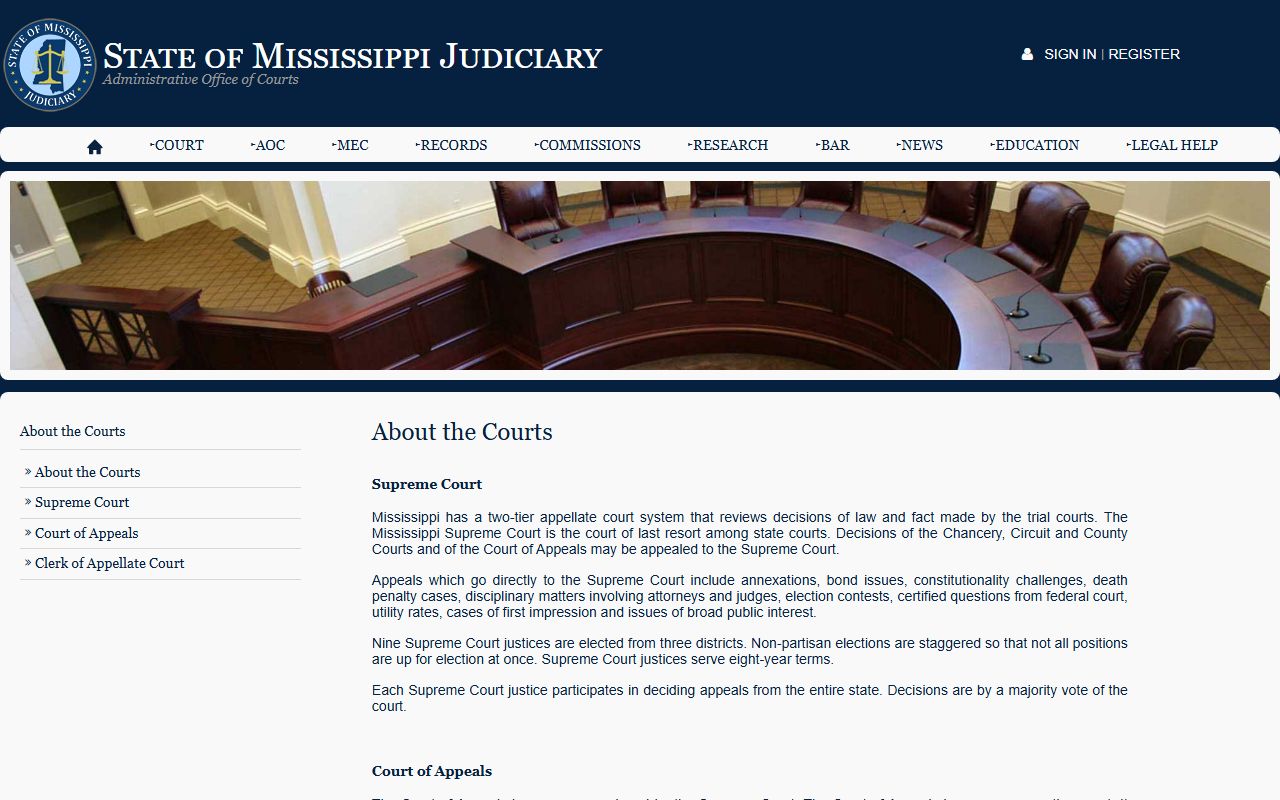
County Court adds another trial layer in Lee County, sharing civil jurisdiction with Circuit and Chancery up to $200,000 and sitting as Youth Court for juvenile matters. Chancery Court handles divorce, estates, land title, guardianships, and commitments. Justice Court and Tupelo Municipal Court handle the smallest civil claims, misdemeanors, traffic, and city ordinance cases. A felony or civil appeal travels upward through this structure to the state's high courts.
Case flow: Justice Court › County Court › Circuit Court › Mississippi Court of Appeals and Supreme Court
| Court | Jurisdiction | Case Types |
|---|---|---|
| Circuit Court | General trial court | Felonies, civil over $3,500, appeals from lower courts |
| County Court | Limited and shared | Civil to $200,000, misdemeanors, eminent domain, Youth Court |
| Chancery Court | Equity | Divorce, probate, land title, guardianship, commitment |
| Justice Court | Lower court | Traffic, misdemeanors, civil to $3,500, evictions |
| Municipal Court | City | Tupelo ordinance and traffic citations |
Types of Court Records Available in Lee County
The records produced in Lee County follow the court that creates them. Circuit and County Courts generate criminal and civil files; Chancery Court generates family, divorce, and probate files; Justice and Municipal Courts generate traffic and small case files. Each file carries the pleadings, orders, and dockets entered as the case moves through that court.
- Criminal records - felony files in Circuit Court and misdemeanors in County, Justice, or Municipal Court, with charges, pleas, and disposition.
- Civil records - complaints, answers, motions, judgments, and executions in Circuit and County Court.
- Family and divorce records - divorce, custody, and domestic matters kept by the Chancery Court.
- Probate records - wills, estates, guardianships, and conservatorships in Chancery Court.
- Traffic records - citations and payments in Justice Court and Tupelo Municipal Court.
Knowing the threshold that separates these courts helps point a search at the right file. The table below compares where the major Lee County courts draw their lines, since several share jurisdiction over the same kinds of cases.
| Court | Civil Limit | Criminal Reach |
|---|---|---|
| Circuit Court | $3,500 and above | Felonies and appeals |
| County Court | Up to $200,000 | Misdemeanors and appeals |
| Justice Court | Up to $3,500 | Misdemeanors and traffic |
| Municipal Court | None | City citations and ordinances |
What Lee County Court Records Show
The fields in a Lee County court record vary by venue, but the Circuit Clerk's duty list gives the clearest local picture. The general court docket holds the names and parties in each case, the plea, the indictment, records from inferior courts on appeal, and other filed papers. The office also keeps orders referenced in the minute book, the execution docket, and a full record of the proceedings. Fine payment instructions show that the offender name and case number serve as the practical identifiers in Circuit Court payment records.
| Field | What It Shows |
|---|---|
| Case Number | Unique identifier used to pull the file and pay fines. |
| Court / Division | Circuit, County, Chancery, Justice, or Municipal venue. |
| Parties | Names of every party entered in the general docket. |
| Charges / Cause | Indictment or civil cause that opened the case. |
| Disposition | Plea, verdict, judgment, or other final outcome. |
| Sentence / Judgment | Fine, sentence, or money award and any costs owed. |
Court files use legal terms that decide how a record reads. The short glossary below covers the words that appear most often across Lee County criminal and civil dockets. A fuller field by field view sits on the Lee County criminal court records page.
- Plaintiff
- The person or entity filing a civil lawsuit.
- Defendant
- The person or entity sued or accused.
- Indictment
- A grand jury charging document for a felony.
- Plea
- The defendant's formal answer to a criminal charge.
- Disposition
- The final outcome of a charge or case.
- Docket
- The chronological list of events in a case.
Public Access Laws for Lee County Court Records
Mississippi policy favors public access. The Mississippi Public Records Act treats government records as open for inspection unless another law makes a record exempt or confidential. Court records fall under that framework along with the rules of the courts that hold them. A public body may require a written request and may charge the actual cost of searching for and copying a record.
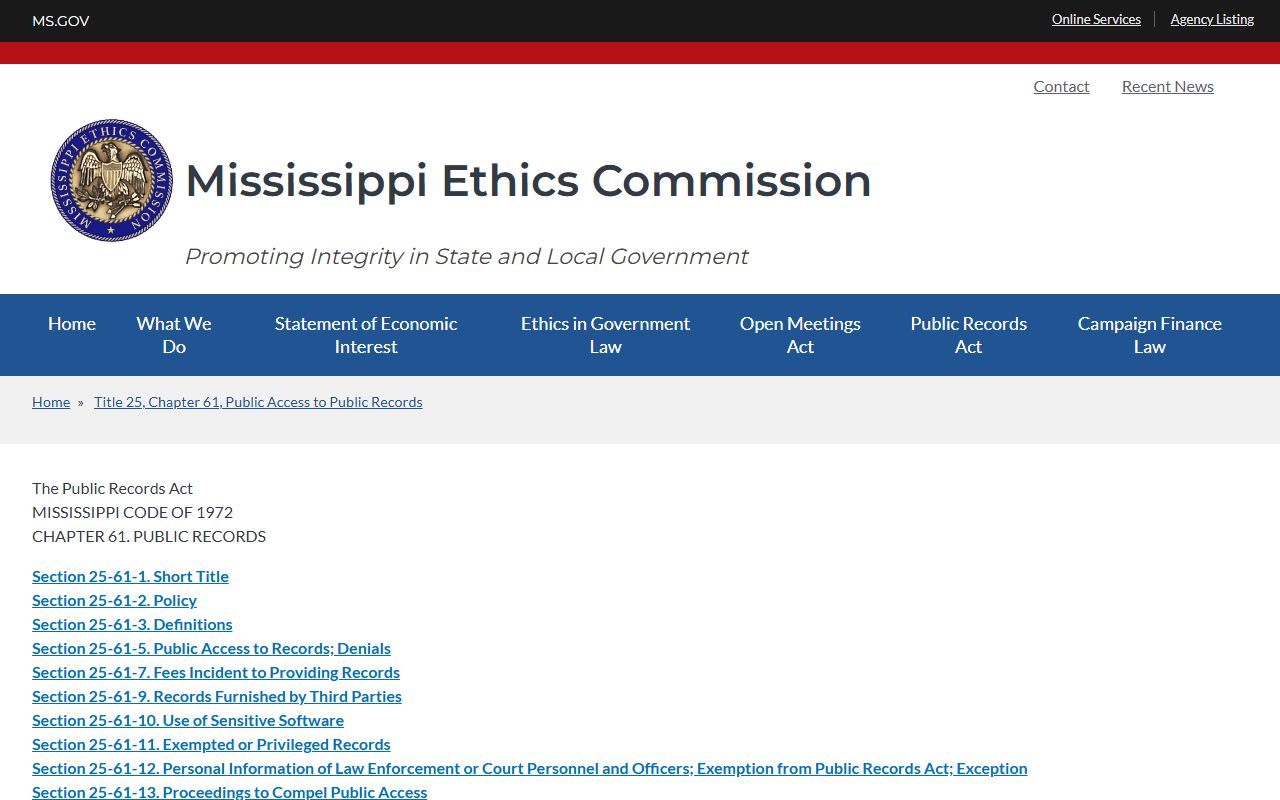
The Mississippi Ethics Commission explains the policy and the request process on its Public Records Act page, which lays out how the law balances openness against narrow exemptions.
Open does not always mean instant. A Lee County court record can be public yet still require an in person inspection, a clerk copy fee, subscriber access, or redaction of protected identifiers. The statutes below shape what is open, what is sealed, and what can be removed.
Key Statutes:
Miss. Code Ann. § 25-61-1 et seq. - the Public Records Act makes government records open unless a specific law exempts them.
Miss. Code § 99-19-71 - eligible misdemeanor and certain felony convictions may be petitioned for expungement in the court of conviction.
Miss. Code §§ 43-21-251 / 43-21-261 - Youth Court records stay confidential except where a statute or a court order allows disclosure.
Miss. Code § 93-17-25 - adoption records are sealed and handled through statutory procedures rather than ordinary copy access.
Records That Are Restricted or Confidential
Several Lee County record types fall outside ordinary public lookup. Youth Court files for children under 18 alleged to need supervision, or to be abused, neglected, or delinquent, are confidential by statute. Adoption records are sealed, and the Chancery Clerk directs the public to an attorney to obtain them. Mental health and commitment matters are Chancery cases, but their health information keeps them out of standard public files. Court files that are otherwise open may still redact Social Security numbers, financial account numbers, the names of minors, and addresses protected by order.
Expungement offers a path to remove some criminal records under Mississippi law. A person generally files a petition in the court where the charge or conviction occurred, whether Justice, Municipal, County, or Circuit. Eligibility turns on the offense type, sentence completion, prior record, and waiting periods, and many violent, sexual, weapon, and serious drug offenses are excluded. When a judge grants the order, the clerk, the sheriff, and state repositories are directed to clear the record from public files.
Note: Sealed, expunged, juvenile, and adoption records should never be treated as ordinary public lookups, and questions about them go to the court that holds the file.
Specialty Courts in Lee County
The First Judicial District Adult Felony Intervention Court, also called Drug Court, serves all seven counties of the First District, including Lee. It is an intense probationary program that requires drug and alcohol treatment, frequent random testing, court appearances, home visits, support meetings, and employment. The minimum commitment runs 36 months across five phases, and participants pay treatment costs and a monthly supervision fee. Acceptance is a joint decision among the defendant's attorney, the Drug Court staff, the District Attorney, and law enforcement, as set out on the program's intervention court page.
Lee County Court also sits as Youth Court, with staff dedicated to delinquency, truancy, abuse and neglect, family defense, child advocacy, and guardian ad litem service. Youth Court records are restricted. The same County Court handles Domestic Abuse Protection Orders, civil orders meant to improve the safety of abuse victims in qualifying relationships. Those filings are court related rather than criminal convictions, and safety sensitive details may be redacted or sealed.
Lee County Sheriff and Jail
Sheriff Jim H. Johnson leads the Lee County Sheriff's Office, headquartered with the Adult Detention Facility at 510 North Commerce Street in Tupelo. The jail holds roughly 200 inmates and houses people for the Sheriff's Office, the city of Tupelo, and other municipalities in the county. The office runs the jail, the juvenile detention center, and a work center for nonviolent offenders.
The Sheriff's Office home page collects its public tools, including inmate search, most wanted, and records, on the Lee County Sheriff's Office site. Those tools are the starting point for arrest, jail, and warrant questions in the county.

The jail's current population appears on a free public roster from Tiger Correctional Services, which lists active inmates, recent bookings, and recent releases. The Sheriff's official mobile app packages inmate search, the sex offender registry, alerts, and anonymous tips into one place. Full roster detail, booking fields, and contact methods sit on the Lee County inmate records page, while active wanted listings and how to clear a warrant are covered on the warrant records page. The charges that follow an arrest are tracked through the arrest records and charges page.
Marriage, Divorce, and Chancery Records
Marriage licenses come from the Lee County Circuit Clerk, which issues the license, files the Statistical Record of Marriage with the state health department, and collects the filing fee. Mississippi has no waiting period, so a couple may apply and marry the same day. Applicants under 21 need parental consent, and the couple arranges its own authorized officiant. Divorce, by contrast, is a Chancery Court matter, and the Chancery Clerk furnishes copies of unsealed divorce files for a per page fee.
Probate, estates, guardianships, and conservatorships are also Chancery Court business. The clerk's counter and the county's Chancery Records Online portal handle land and property records, while sealed family matters require court authorization. The Lee County marriage and divorce records page and the Chancery Court records page walk through each request channel and the fees that apply.
- Testator
- A person who makes a valid will.
- Executor
- The person named to carry out a will.
- Conservator
- A person appointed to manage another's property or finances.
Lee County Court Records Fees
Copy and certification fees are set locally and differ by office. The Chancery Clerk publishes the clearest schedule, charging less when a member of the public makes the copy and more when staff do it. The Circuit Clerk collects set fees on marriage licenses and certified copies. Mail requests must include payment and a stamped return envelope, with checks payable to the office that holds the record.
| Item | Amount |
|---|---|
| Chancery copy made by the public | $0.25 per page |
| Chancery copy made by staff | $0.50 per page |
| Chancery certification | Additional $1.00 |
| Marriage license filing fee | $37 |
| Certified copy of marriage license | $17 |
| Additional marriage license copy | $6 |
Federal Court Records Near Lee County
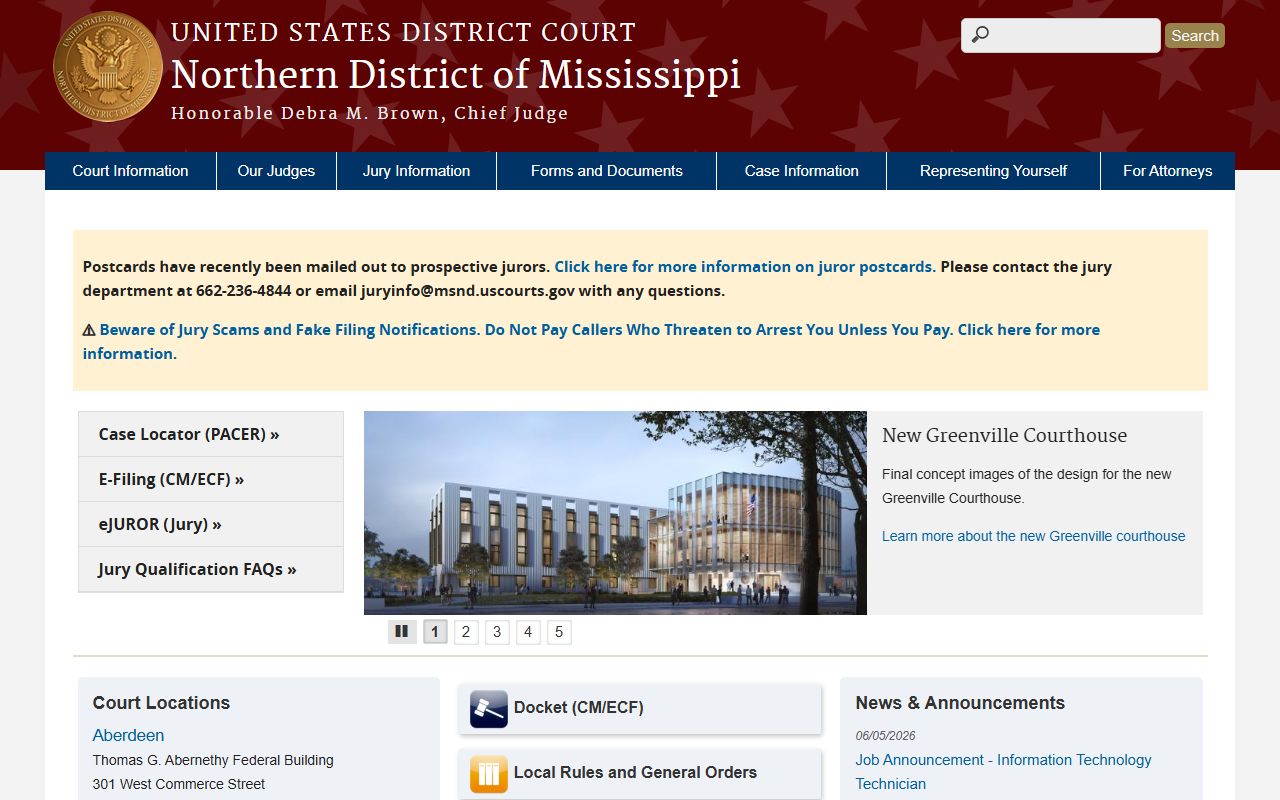
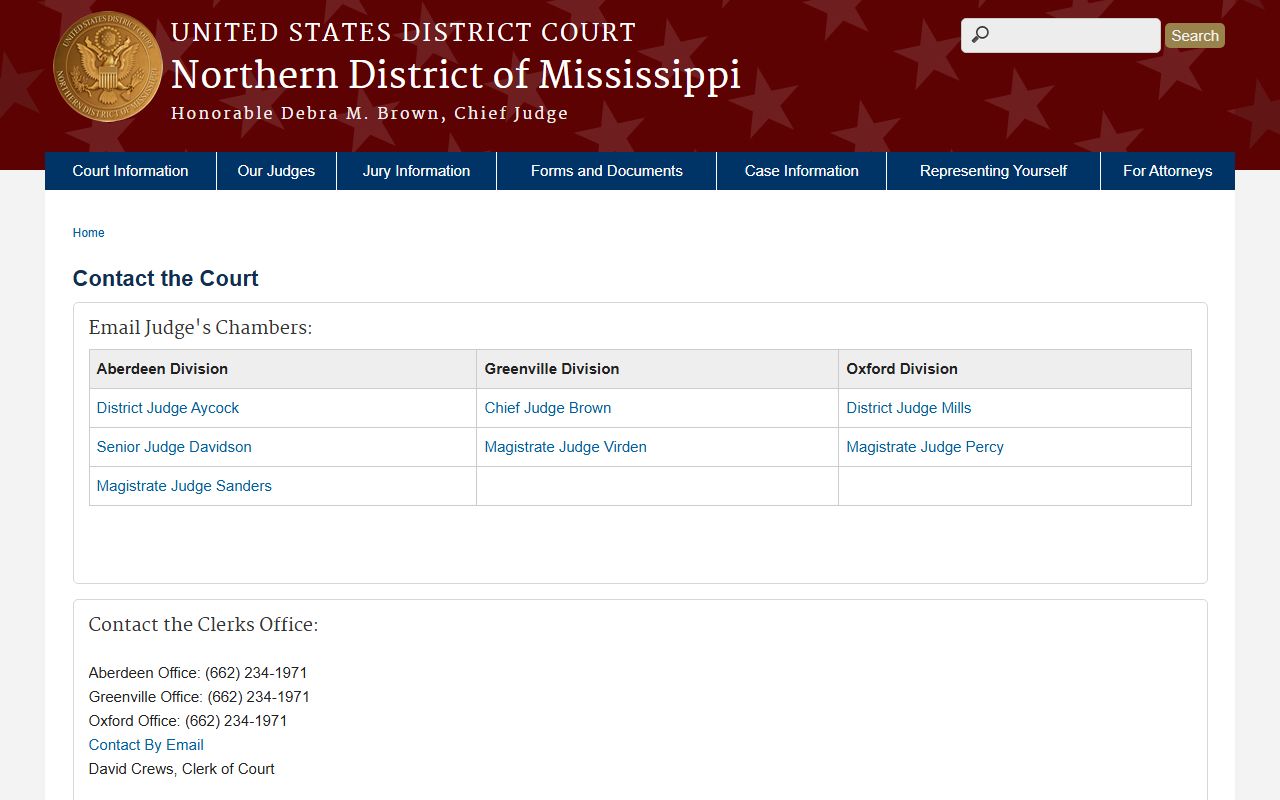
Cases that fall under federal law are separate from Lee County court records. Lee County lies within the U.S. District Court for the Northern District of Mississippi, which holds court in Aberdeen, Greenville, and Oxford. The Oxford courthouse is the nearest federal facility to Tupelo. Federal court handles federal crimes, civil rights suits, federal question and diversity cases, and other matters outside the county courts.
The Northern District publishes its locations, calendars, and contacts on the Northern District of Mississippi site. That page is the authoritative starting point for anyone tracing a federal case tied to the Tupelo area.
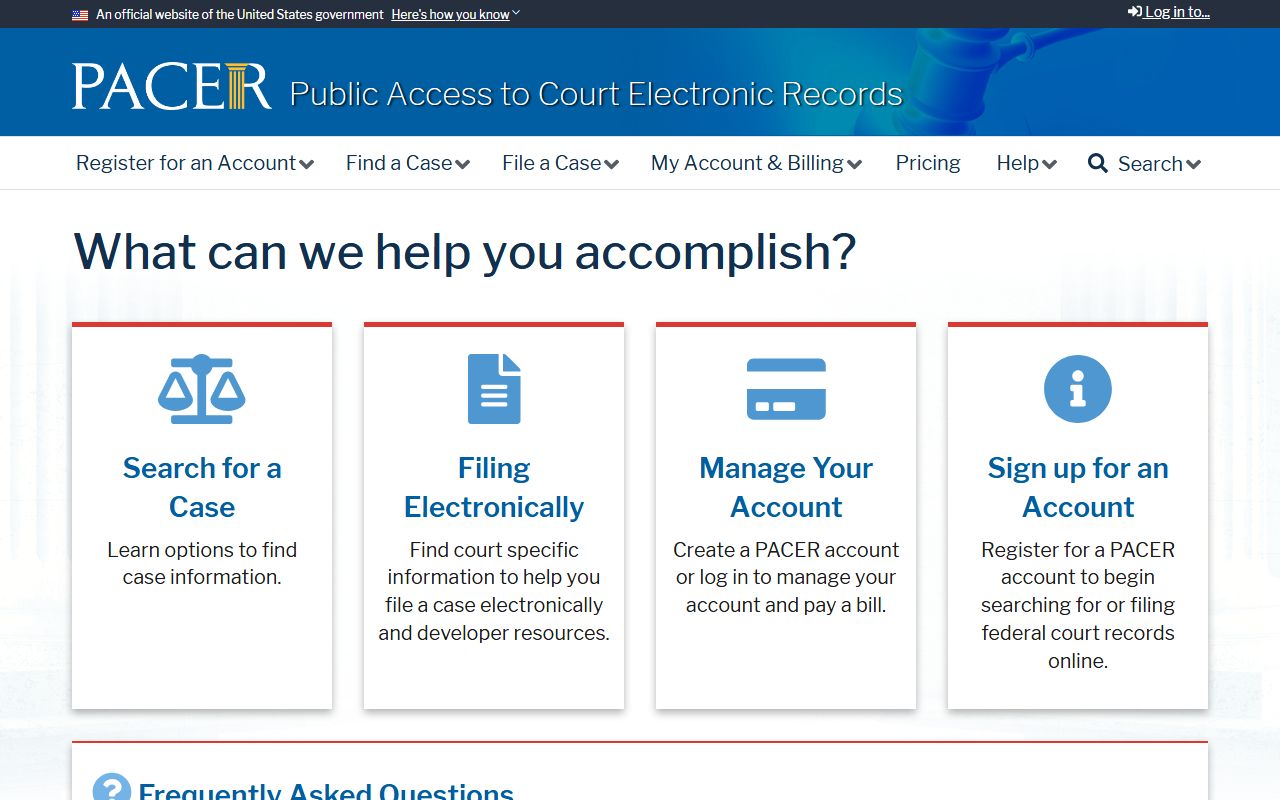
Federal case documents themselves live in PACER, the national electronic records system. A case search account costs nothing to open, and per page fees are waived for users who stay at or below a small quarterly threshold. The fee structure and registration steps appear on the PACER portal.
Procedural, electronic filing, jury, and technical questions each have their own line and email at the district. Those routing details are listed on the court's contact page, which directs callers to the right office for federal matters.
Federal courthouse rules are stricter than county practice, with government ID, x-ray screening of bags, and limits on electronic devices inside courtrooms.
Courthouse Location and Contact Information
Modern court operations run from the Lee County Justice Center at 200 West Jefferson Street in downtown Tupelo. The Circuit Clerk keeps Circuit, County, and Youth Court records on the building's lower floors, County and Youth Court sit on the third floor, and the Chancery offices share the same Justice Center address. The Sheriff's Office and jail stand a few blocks away on North Commerce Street. Because record access can span more than one office, callers often confirm which counter holds a file before visiting.
Lee County Justice Center
200 West Jefferson Street
Tupelo, MS 38804
Circuit Clerk (662) 432-2300
Monday-Friday 8:00 a.m.-5:00 p.m.
Note: Dockets and court calendars change often, so confirm a hearing date with the Circuit Clerk or the relevant court administrator rather than relying only on a cached online list, as covered on the court dockets page.
History of Lee County Courts
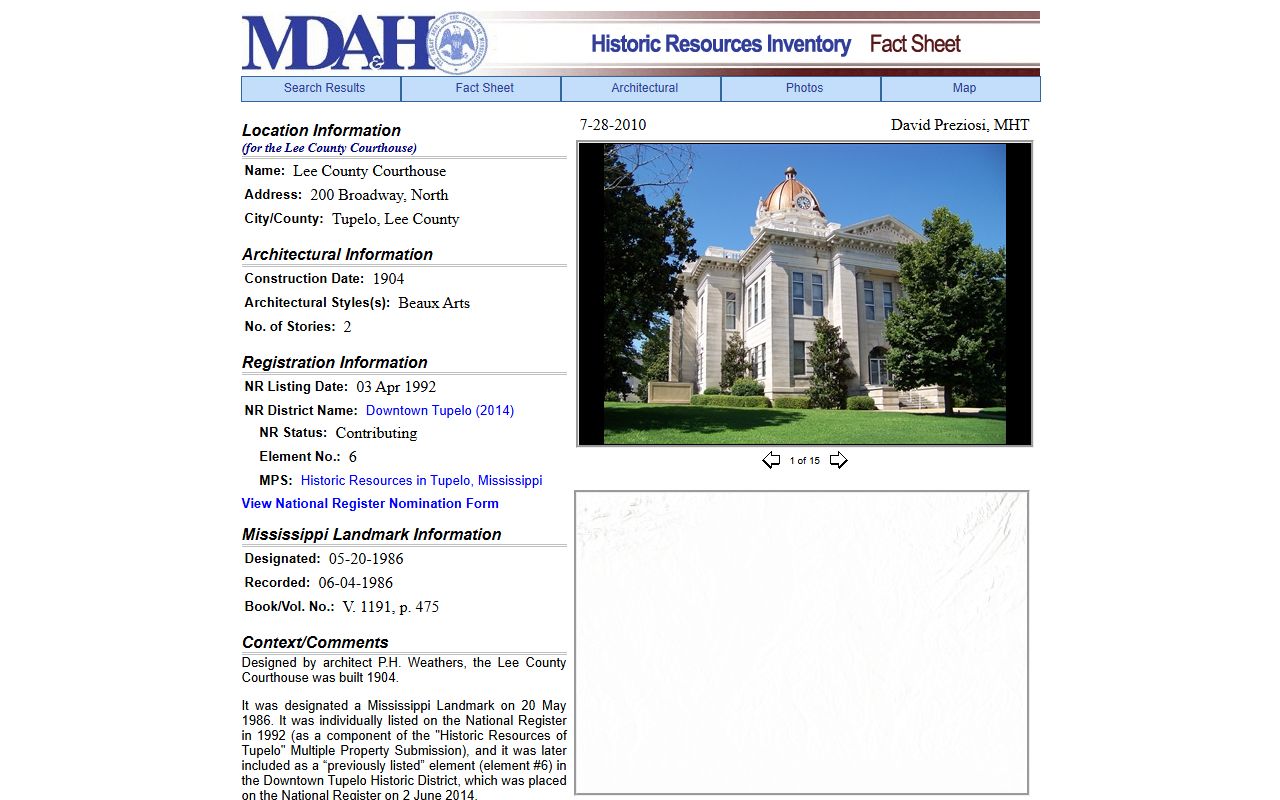
The historic Lee County Courthouse was built in 1904 to a design by architect P.H. Weathers. It became a Mississippi Landmark in 1986, was listed on the National Register in 1992 as part of the Tupelo multiple property submission, and was later folded into the Downtown Tupelo Historic District. Early descriptions note a stone building lighted by electricity, tied to the town water system, and topped by a tile roof and cupola.
The Mississippi Department of Archives and History keeps the building's documented record, including its architect and landmark dates, in its Lee County Courthouse property record. That archive anchors the local history that surrounds the county's courts.
Today the courts work from the Justice Center rather than the old courthouse, a shift that separates the historic landmark from daily record access. The county's layered structure, with separate Circuit, County, Chancery, Justice, and Municipal Courts, reflects Mississippi's tradition of distributing trial work across several venues instead of a single courthouse database.
Frequently Asked Questions
Are Lee County court records public?
Most are. The Mississippi Public Records Act treats government records as open for inspection unless a specific statute, court rule, or court order restricts them. A record can be public yet still require an in person visit, a copy fee, or subscriber access. Youth Court, adoption, sealed, and expunged records sit outside ordinary public lookup and are handled through the court that holds them.
Where do I search Lee County criminal records?
Felony cases are Circuit Court records, kept by the Circuit Clerk at the Justice Center in Tupelo. Misdemeanors may sit with County, Justice, or Tupelo Municipal Court depending on where they were charged. Start with the Circuit Clerk for felony files, and use the issuing lower court for smaller offenses.
How do I find divorce or probate records?
Divorce, probate, estate, and guardianship files are Chancery Court records. The Chancery Clerk furnishes copies of unsealed files for a per page fee, and the county's Chancery Records Online portal helps with land and property records. Sealed family matters and adoption records require court authorization or an attorney.
Is there a free online jail roster?
Yes. The Lee County Sheriff's Office links to a free Tiger Correctional Services roster that lists active inmates, recent bookings, and recent releases, searchable by last name. The Sheriff's mobile app also offers inmate search. The roster covers county detention only, not sentenced state prisoners, who appear in the Mississippi Department of Corrections search.
How much do copies cost?
The Chancery Clerk charges $0.25 per page for copies the public makes, $0.50 per page for staff copies, and an extra $1.00 for certification. A marriage license filing fee is $37, a certified copy is $17, and each additional copy is $6. Mail requests must include payment and a stamped return envelope.
Can I check for a warrant online?
Lee County does not post a full active warrant search. The Sheriff's Most Wanted page lists selected wanted persons, and the office notes that online data may be out of date for legal purposes. To confirm a warrant, call the issuing court or the Sheriff's Office, since a phone check is more reliable than a routinely updated list.
How do I get a marriage license in Lee County?
Call the Circuit Clerk for an appointment, then apply in person. Mississippi has no waiting period, so the license is issued the same day and the ceremony may follow at once. Applicants under 21 need parental consent, and the couple arranges its own authorized officiant.
Can a Lee County record be expunged?
Some can. Mississippi allows expungement by petition for eligible records, filed in the court where the charge or conviction occurred. Eligibility depends on the offense, sentence completion, prior record, and waiting periods, and many serious offenses are excluded. A granted order directs the clerk, sheriff, and state repositories to clear the record.